
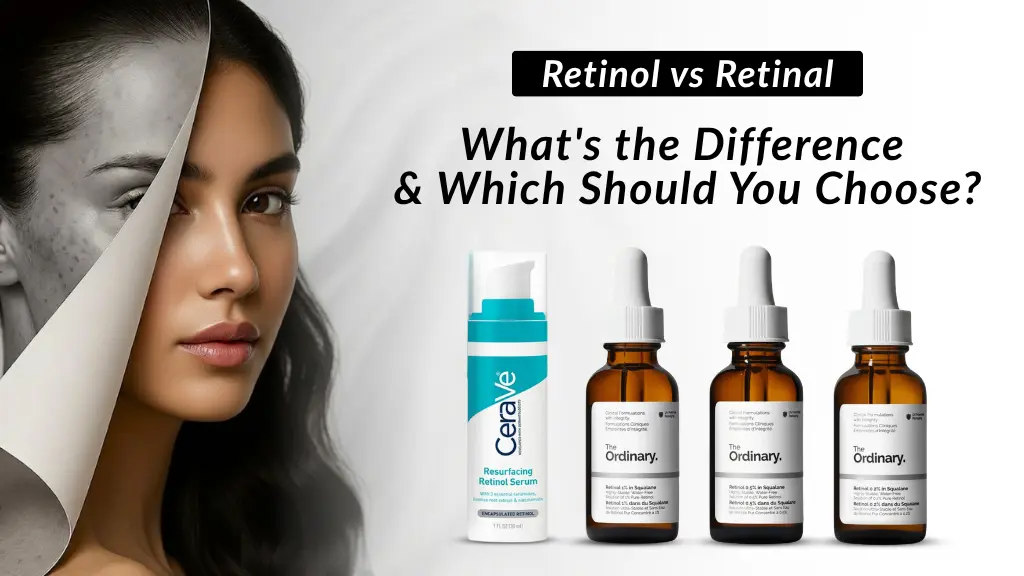
If you’ve been exploring skincare for fine lines, uneven skin tone, acne marks or signs of ageing, you’ve probably come across both retinol and retinal.
They sound almost identical, but there is an important difference between them. Both are vitamin A derivatives, but they follow slightly different conversion pathways in the skin.
So, which one should you choose?
What Is Retinol?
Retinol is a form of vitamin A commonly used in cosmetic skincare. Once applied to the skin, it needs to undergo conversion before becoming retinoic acid, the biologically active form that interacts with retinoid receptors.
Retinol is widely used in skincare routines targeting:
- Fine lines and wrinkles
- Uneven skin texture
- Uneven skin tone
- Signs of photoaging
- Acne prone skin
Because it is available in different strengths and formulations, retinol can be a practical starting point for people who are new to vitamin A skincare.
What Is Retinal?
Retinal, also called retinaldehyde, is another vitamin A derivative.
The key difference is its position in the conversion pathway: retinal is converted to retinoic acid in one step, whereas retinol requires an additional conversion step.
Research has demonstrated biological activity and good tolerance with topical retinaldehyde, although individual products can vary significantly in concentration and formulation.
Retinol vs Retinal: What’s the Difference?
| Feature | Retinol | Retinal |
|---|---|---|
| Vitamin A derivative | Yes | Yes |
| Conversion to retinoic acid | More steps | Fewer steps |
| Typical cosmetic use | Anti-ageing, texture, tone | Anti-ageing, texture, tone |
| Beginner-friendly option | Often | Depends on formula |
| Irritation possible | Yes | Yes |
| Available at Glow Marketing | Yes | Currently not listed |
The important point is that retinal isn’t automatically better simply because it is closer to retinoic acid. Formula stability, concentration, skin tolerance and consistent use all matter.
Which Should You Choose?
Choose Retinol If You’re New to Vitamin A
If you’ve never used a retinoid before, starting with a lower-strength retinol product can be a reasonable approach.
Glow Marketing’s range includes:
- The Ordinary Retinol 0.2% in Squalane
- The Ordinary Retinol 0.5% in Squalane
- The Ordinary Retinol 1% in Squalane
- CeraVe Resurfacing Retinol Serum
- Pixi Retinol Tonic
These give shoppers several retinol formats and strengths to consider.
Consider Retinal If You Want a More Direct Retinoid Pathway
Retinal may appeal to experienced skincare users who want a vitamin A derivative that requires fewer conversion steps before becoming retinoic acid.
However, retinal products aren’t automatically suitable for everyone, and Glow Marketing’s current catalog focuses on retinol rather than retinal.
How to Start Using Retinol
Start slowly rather than applying it every night immediately.
A simple evening routine can be:
Cleanser → Retinol → Moisturizer
Begin according to the product’s instructions and increase frequency only as your skin tolerates it.
Avoid introducing several strong active ingredients at the same time.
Retinoids can cause dryness and irritation, particularly when first introduced.
Don’t Forget Sunscreen
If you’re using retinol or another retinoid in your routine, daily sun protection is important.
Use a broad spectrum sunscreen during the day and avoid assuming that stronger retinoid use will compensate for inadequate sun protection.
Final Thoughts
Retinol and retinal are both vitamin A derivatives, but they’re not exactly the same. Retinal sits closer to retinoic acid in the conversion pathway, while retinol generally offers a more gradual approach.
If you’re starting your vitamin A journey, Glow Marketing’s range gives you several retinol options, including The Ordinary Retinol 0.2%, 0.5% and 1% in Squalane, CeraVe Resurfacing Retinol Serum and Pixi Retinol Tonic.
Choose based on your experience level, skin tolerance and skincare goals rather than simply choosing the strongest percentage.
FAQ
01. Is retinal stronger than retinol?
Retinal requires fewer conversion steps to become retinoic acid, but that doesn’t mean every retinal product will be stronger than every retinol product. Concentration and formulation also matter.
02. Which is better for beginners: retinol or retinal?
A lower-strength retinol can be a practical starting point for beginners. Start gradually and follow the product instructions.
03. Can retinol reduce fine lines?
Retinoids are widely used in cosmetic skincare for signs of photoaging, including fine lines and uneven skin texture.
04. Can retinol help acne?
Retinoids can be useful in acne care, although persistent or moderate-to-severe acne may require dermatologist-directed treatment.
05. Can I use retinol every night?
Not necessarily. Start according to the product instructions and increase frequency gradually if your skin tolerates it.
Leave a Reply